
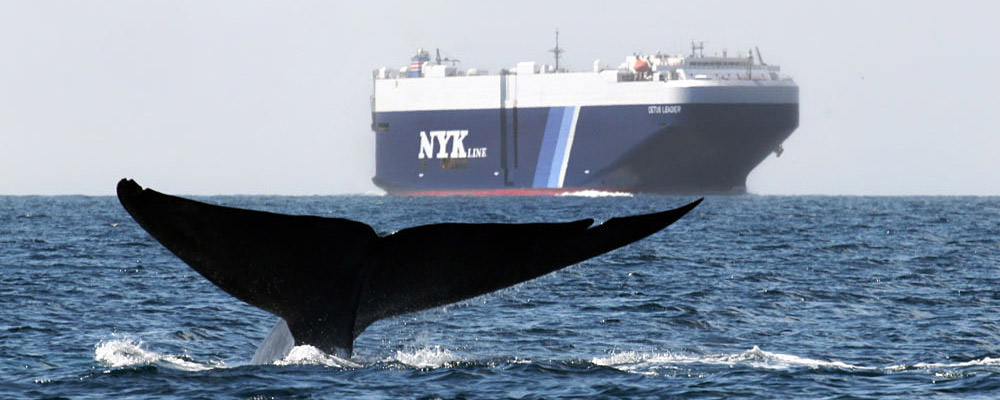
On April 22nd, the Protecting Blue Whales and Blue Skies Program (BWBS) launched its 2026 Vessel Speed Reduction Season, extending protections for the first time along the entire California coast under Assembly Bill 14 (Hart). This expansion marks a milestone for a program that began over a decade ago in the Santa Barbara Channel.
Ships and Whales on a Collision Course
Global shipping traffic overlaps with an estimated 92 percent of whale habitat ranges. Each year, thousands of cargo ships transit California’s coast through critical feeding and migration corridors for endangered blue, humpback, and fin whales – increasing the likelihood of fatal ship strikes and contributing to ocean noise pollution that masks the signals marine species depend on for navigation and foraging.
While roughly 10 whale strikes per year are officially recorded along the West Coast, Point Blue Conservation Science estimates as many as 83 endangered whales may be killed annually. Dead whales often sink before they are found or wash ashore too decomposed to confirm a cause of death.
How the Program Works
The Vessel Speed Reduction program asks oceangoing vessels of 300 gross tons or larger to slow to 10 knots or less within designated zones. At those reduced speeds, the risk of a fatal strike drops significantly, and underwater noise can be reduced by nearly 40 percent. To incentivize participation, BWBS verifies compliance and publicly recognizes top-performing shipping lines.
The 2026 season brings important and meaningful changes. The Vessel Speed Reduction zone now extends statewide and further west, creating a more continuous and comprehensive protective corridor, and the season start date moved from May 1 to April 22 due to irrefutable evidence that whales are arriving earlier as ocean conditions shift with climate change. Last year, there were at least 24 days in April alone with five or more endangered whale sightings in Southern California, underscoring the need for earlier protections.
Steps in the Right Direction – But Steps Too Small
California Coastkeeper Alliance has been a long-time supporter of the Vessel Speed Reduction program, including legislation in 2019 that would have established it as a statewide program. While we support the program’s season and geographic scope expansions in 2026, the current expansions do not go far enough.
On the season: the historical May 1 start date does not line up with whale presence patterns in California feeding grounds. Whales are arriving earlier in the spring and staying longer into the winter. The BWBS program itself concluded that data supports an April 1 start date – yet for 2026, the season begins April 22 to allow more time for industry preparedness. Even April 1 may be insufficient. The same data set shows at least 10 days in March 2024 and 11 days in February 2024 with five or more endangered whale sightings in Southern California. A February or March start date is warranted.
On the zone: historically, the Vessel Speed Reduction zone was comprised of multiple, disjointed areas along the central and southern coast, failing to include Biologically Important Areas where whales concentrate to reproduce, feed, and migrate. Because of those gaps, shipping companies routed around the zones at higher speeds, displacing impacts rather than reducing them. While the 2026 zone is more continuous, it still does not cover all Biologically Important Areas. The originally proposed expansion would have extended further west, but after industry pushback, it was scaled back, leaving many threatened and endangered whales at risk.
Looking Ahead
The BWBS program represents real progress. But with endangered whale populations under mounting pressure from changing ocean conditions, diminishing prey, and intensifying shipping traffic, science demands stronger protections.

Staff Attorney Marty Farrell advocates for statewide policies and programs that protect the health of California’s water.